Many entrepreneurs discover Businesses for Sale in Costa del Sol for many reasons. Some after falling in love with the region. From Marbella to Fuengirola, every town offers its own character and customers. Commercial opportunities are a no miss too. Busy cafés welcome morning regulars. Restaurants and retail businesses benefit enough. They gain mainly from steady visitor numbers throughout the year. Buying an established business means stepping into something already operating. It is not like starting with an empty premises. That appeals to buyers looking for a smoother move into business ownership. Mind Your Own Business® presents opportunities across the Costa del Sol. It covers different industries, budgets, and locations. Every listing includes practical information. It allows buyers to compare options before arranging a viewing. With the right business in the right location, the next chapter can begin from day one.
RTF Editor Component
RTF
editor component , often called
what you see is what you get. This can be used as standalone applications. Buy
this RTF editor component tool allows viewing and editing RTF text,
mail-merging and printing. This tool control supports formatted text, pictures,
tables and much, much more. It is by far one of the most powerful and
user-friendly tool used in business.

Sub Systems | RTF Editor Component | Snagged On: November 10, 2026
;VAPT Report for E-commerce and Retail: How to Act on Findings
VAPT Report for E-commerce and Retail: Turning Findings
Into Action Before the Next Sale
An online retailer is three weeks from a major festive
campaign. Marketing has planned discounts, the logistics team has forecast
order volumes, and the technology team is preparing for a surge in traffic.
Then the security team receives a VAPT report with 84 findings.
Some are marked critical, others informational, and a few appear to affect the
checkout flow. The real question is not how many issues exist; it is which ones
could expose customer data, disrupt orders or interfere with payments during
the campaign. That is the practical value of a VAPT report.
For e-commerce platforms, marketplaces, omnichannel
retailers, D2C brands and retail chains in India, a VAPT report should
translate technical findings into business priorities. It should help teams
protect checkout, customer accounts, payment data, loyalty programmes,
inventory systems and third-party integrations without delaying every release.
Why an e-commerce VAPT report needs business context
A generic vulnerability report can be difficult to act on
because it often lists issues by technical severity alone. In retail, severity
should also reflect commercial impact. A flaw that exposes product descriptions
may be inconvenient; a flaw that lets an attacker change prices, access
customer addresses, manipulate coupons or interfere with payment confirmation
is a different matter.
A useful vulnerability
assessment and penetration testing report therefore connects each finding
to the asset and workflow it affects. It should distinguish between issues in
the public storefront, customer account area, checkout journey, administrative
panel, mobile app, API layer, cloud environment and internal retail systems.
Without that context, engineering teams may spend days fixing low-impact issues
while a higher-risk checkout or account-recovery flaw remains open.
The report should also state the testing scope clearly. Did
it cover the web store only, or did it include mobile apps, APIs, payment
integrations, loyalty systems, warehouse interfaces and cloud infrastructure? A
report that looks comprehensive but excludes key revenue paths can create false
confidence.
What a good report should contain
A strong VAPT report is not just a list of vulnerabilities.
It should give different readers what they need to make decisions.
For leadership, it should include an executive summary
explaining the overall risk position in commercial terms: customer data
exposure, payment integrity, fraud risk, operational disruption and
reputational impact. For security and engineering teams, it should provide
validated findings, affected components, exploitation evidence, severity
ratings and specific remediation guidance. For compliance and audit teams, it
should show methodology, scope, limitations, remediation status and retest
evidence.
Each material finding should answer four questions: what is
weak, how was it validated, what could an attacker achieve, and what should be
fixed first. “SQL injection in the search function” is technical information.
“An unauthenticated user can extract customer records through the search
endpoint, affecting personal and order data” is a business risk that can be
prioritised.
How to prioritise findings before a sale campaign
Retail teams often face pressure to fix everything at once.
That rarely works. A better approach is to group findings by potential impact
on revenue, customer trust and operations.
|
Finding type |
Why it matters in retail |
Typical priority |
|
Checkout, payment or order-integrity flaw |
Can affect transactions, refunds, fraud and customer trust |
Fix before launch |
|
Customer account or personal-data exposure |
Can lead to identity misuse, phishing and regulatory
concern |
Fix before launch |
|
Admin panel or privilege escalation |
Can allow catalogue, price, promotion or customer-data
manipulation |
Fix before launch |
|
Public storefront content issue |
May affect brand trust but usually has narrower impact |
Schedule based on risk |
|
Performance or configuration weakness |
May become significant during traffic spikes |
Assess operational exposure |
This table is a starting point, not a substitute for
validation. A medium-rated issue in a payment confirmation flow may deserve
more attention than a high-rated issue in a non-sensitive internal tool. The
report should give enough evidence for the retailer’s own team to make that
judgement.
The retail workflows testers should examine
In an e-commerce environment, testers should look beyond
conventional web vulnerabilities. They should examine the rules that make
retail work: discounts, coupons, cart behaviour, shipping charges, taxes,
returns, refunds, loyalty points and order cancellation.
For example, a tester may check whether a coupon can be
reused after it has expired, whether a discount intended for one customer
segment can be applied by another, whether a cart total can be altered through
an API request, or whether an order status can be changed after payment. These
are business-logic issues. They may not appear in a standard scanner output,
but they can directly affect margin, fraud losses and customer disputes.
Customer account flows also deserve close attention.
Password reset, OTP verification, account recovery, address book access, saved
cards, order history and profile updates are frequent targets. A weakness that
allows one customer to view or modify another customer’s details can quickly
become a trust and compliance problem.
Payment data needs careful handling
Retailers often assume that using a payment gateway removes
most payment-security responsibility. The gateway may reduce exposure, but the
retailer still owns the surrounding environment: checkout pages, redirects,
webhooks, order records, customer support tools, analytics tags and third-party
scripts.
A VAPT report should examine whether payment-related pages
are protected from script injection, whether webhook endpoints validate the
source and integrity of messages, whether order data is exposed through
insecure APIs, and whether support or admin users can access more payment
information than they need. It should also identify where cardholder data may
be present, even indirectly, through logs, screenshots, support tickets or
analytics tools.
For businesses that store, process or transmit card data,
PCI DSS requirements may apply. The exact obligations depend on the payment
model and integration method, so the current PCI SSC requirements and the
retailer’s card-brand or acquirer guidance should be checked. A VAPT report can
support that programme, but it does not by itself make an organisation
compliant.
What to do after receiving the report
The first action is validation, not panic. The internal team
should review each material finding, confirm that it affects the intended asset
and environment, and check whether compensating controls already reduce the
risk. Sometimes a finding is valid but less severe because of network
segmentation, access restrictions or a control not visible to the tester.
The second action is ownership. Every finding needs a named
owner, a target date and a clear remediation plan. Where the issue sits in a
third-party platform, plugin, theme, marketplace integration or managed
service, the retailer should identify the responsible vendor and obtain a
written fix commitment.
The third action is retesting. A fix should be verified
against the original finding, not assumed to be complete because a new scan
shows fewer alerts. Retest evidence is particularly valuable when the report
will be shared with a payment partner, enterprise customer, marketplace or
auditor.
Finally, update the risk register. Record what was found,
what was fixed, what was deferred, who approved any exception and when the next
review is due. This record becomes useful during vendor assessments, PCI DSS
reviews, insurance discussions and internal audits.
Common mistakes retail teams make
One common mistake is fixing only critical findings.
Critical issues deserve urgency, but high-risk issues affecting customer
accounts, checkout logic or admin access can also cause substantial harm.
Severity ratings help prioritisation; they should not become the only decision
filter.
Another is treating third-party scripts and plugins as low
risk. Retail sites often use analytics tags, chat widgets, ad trackers, review
tools, personalisation engines and marketing pixels. A compromised script or
plugin can affect checkout pages and customer sessions. The report should
identify these dependencies, and the retailer should maintain an inventory of
them.
A third mistake is testing only before a major campaign and
then ignoring changes made during the campaign. Flash sales, new payment
options, temporary landing pages, promotional APIs and urgent configuration
changes can introduce new exposure. A lightweight change-review process helps
prevent a festive-season release from undoing earlier security work.
How often should e-commerce and retail test?
Frequency should follow change and exposure. A high-traffic
online store with frequent releases, multiple payment options and a large
customer base should test more often than a small catalogue site with stable
technology. Major releases, new integrations, platform migrations and seasonal
campaigns are sensible triggers for focused testing.
For a retailer with both online and physical operations, the
scope should not stop at the website. Point-of-sale systems, store networks,
inventory applications, supplier portals and staff devices can all become entry
points. A retailer may not need to test every store system in every cycle, but
it should understand which systems connect to customer data, payment processes
or central business applications.
Questions to ask before accepting a report
Ask whether the report includes business-logic testing for
checkout, coupons, refunds, loyalty and order workflows. Ask whether APIs,
mobile apps, admin panels and cloud configuration were covered. Ask for
exploitation evidence for material findings. Ask how third-party components and
integrations were handled. Ask whether retesting is included and what closure
evidence will be provided.
A report that cannot answer these questions may satisfy a
checkbox, but it will not help a retail technology team make confident
decisions before a high-volume sales period.
IBN Technologies provides VAPT services for e-commerce and
retail businesses in India, including application, API, mobile, cloud and
network testing, with prioritised reporting, remediation support and retesting.
Contact Us
IBN Technologies
Phone: +91 20 6768 0404
Email: sales@ibntech.com

Danny Patil | VAPT Report for E-commerce and Retail: How to Act on Findings | Snagged On: November 05, 2026
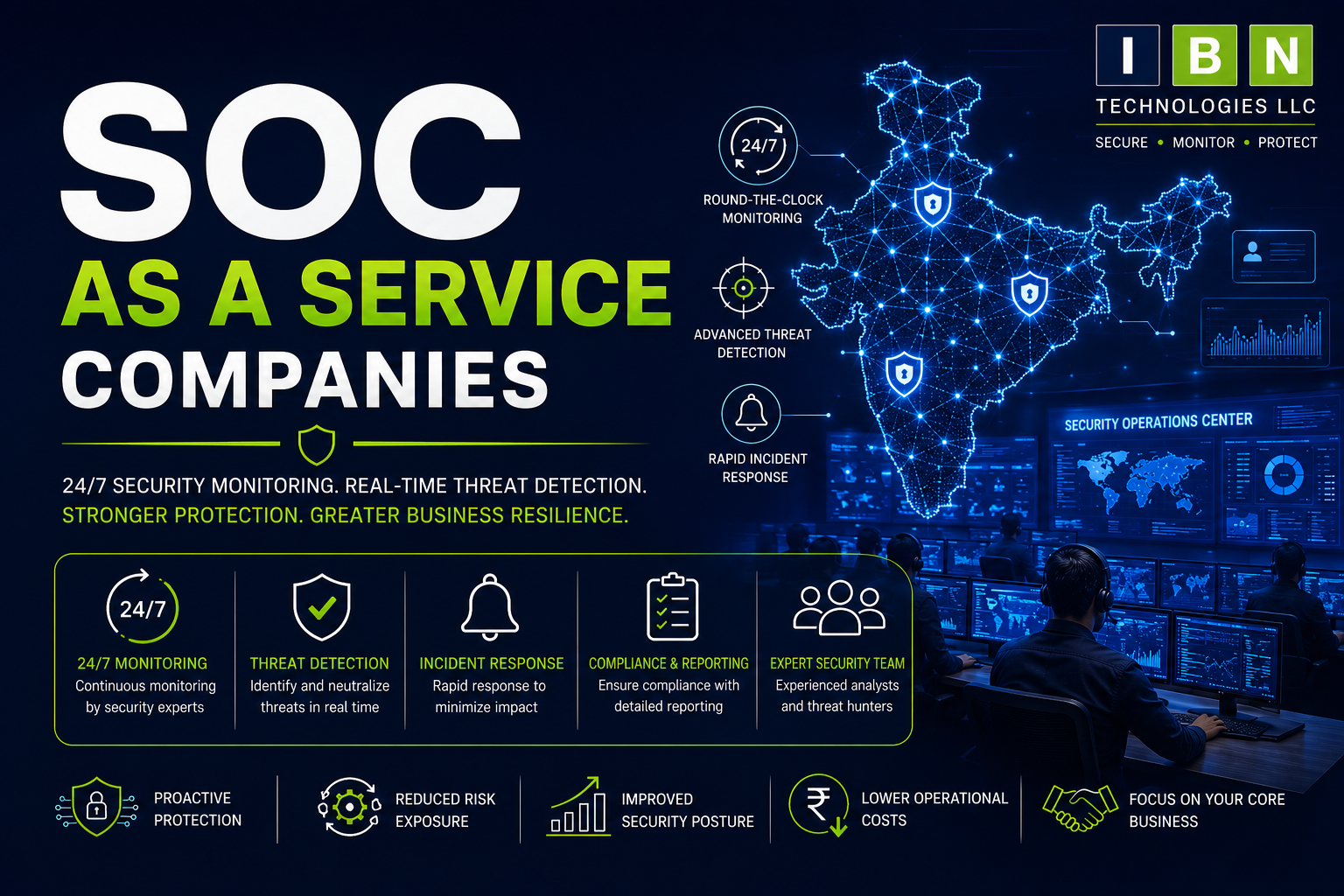
;Are SOC as a Service Companies Right for Indian Retail?
SOC as a Service Companies: What Retail Leaders Get Wrong
Retail and e-commerce businesses often assume that
outsourcing security monitoring means losing control or buying a standard
package that ignores their operations. Soc as a service
companies can provide continuous threat detection, investigation and
response support, but the value depends on how well the provider understands
retail systems, seasonal traffic and third-party connections.
The mistake many retailers make is comparing providers only
on price or tool names. Two services may both promise 24x7 monitoring, yet one
may cover cloud accounts, identity systems and application logs while the other
monitors only network devices. The difference becomes visible only when an
incident affects checkout, customer accounts or order fulfilment.
Why Retail Security Needs More Than Fraud Tools
Fraud-prevention systems focus on transaction risk, customer
behaviour and payment anomalies. They are necessary, but they do not always
detect a compromised administrator account, a malicious change to a checkout
page or unusual access to customer databases.
SOC as a service companies address a different layer of
risk. They monitor security signals across web applications, cloud
infrastructure, employee endpoints, identity systems and third-party
integrations. Their objective is to identify compromise early, before it
becomes a service disruption or data exposure.
Retail environments are especially dynamic. Festive
campaigns, flash sales, new payment options, marketplace integrations and
delivery-partner connections can all change normal traffic patterns. A provider
must understand these changes to avoid treating seasonal activity as an attack.
What SOC Security Services Should Cover
Strong soc
security services for retail begin with visibility across the systems that
affect revenue and customer trust. These may include e-commerce platforms,
content management systems, cloud accounts, identity providers, employee
endpoints, email security, network devices and application logs.
Detection rules should reflect retail risks. Useful signals
include unusual administrative access, unexpected changes to checkout or
payment-related pages, abnormal data exports, compromised staff accounts,
suspicious API behaviour and indicators of website compromise.
After an alert is confirmed, the provider should investigate
its scope and escalate according to an agreed plan. A suspicious change on a
checkout page, for instance, may require isolating affected systems, preserving
evidence and informing the internal web and payments teams.
How Do SOC as a Service Companies Work?
The engagement begins with scoping. The retailer and
provider identify critical systems, data flows, authorised users, vendor
connections and escalation contacts. The provider then connects approved data
sources and validates that logs arrive reliably.
Once monitoring is live, analysts review alerts
continuously. They separate genuine threats from false positives, investigate
suspicious patterns and document their findings. When containment is needed,
the provider follows the agreed response plan.
The provider should also report recurring weaknesses.
Repeated failed logins, excessive privileged access, unpatched systems and weak
vendor controls should be flagged for improvement. Monitoring should reduce
future risk, not only record past alerts.
When Does Outsourcing Make Sense for Retail?
Outsourcing makes sense when the retailer needs continuous
coverage but cannot justify a full internal security team. Online stores,
multi-brand retailers and businesses with physical stores often need monitoring
outside standard working hours.
It also makes sense when internal IT teams are already
stretched. Store operations, website changes, marketplace integrations and
seasonal campaigns demand attention. A SOC as a service company can take
responsibility for continuous detection while internal teams focus on business
operations.
The model works best when responsibilities are clear. The
provider monitors, investigates and escalates. The retailer approves critical
containment actions, manages vendor relationships and decides how to
communicate with customers or partners.
What Should Retailers Evaluate Before Signing?
Ask how the provider handles peak periods. A festive sale
can create a surge in legitimate traffic, and the provider should explain how
it separates seasonal behaviour from suspicious activity without flooding the
internal team with false alerts.
Ask about e-commerce familiarity. The provider should
understand the difference between a compromised marketing site, an exposed
admin account and suspicious activity around checkout or payment flows. Each
situation requires a different response.
Ask about integration with existing tools. Many retailers
already use cloud security services, endpoint protection, web application
firewalls and fraud platforms. The SOC should work alongside those tools rather
than demand a complete replacement.
What Can Go Wrong With Outsourced Monitoring?
Incomplete scope is a common failure. A retailer may monitor
its online store but ignore warehouse systems, store networks, employee
endpoints or third-party integration accounts. Attackers often enter through
less-visible parts of the environment.
Unclear authority is another risk. If the SOC detects a
compromised administrator account but no one can approve suspension or endpoint
isolation, response slows down. Retailers should define approval rights and
backup contacts before go-live.
Over-reliance on alerts is a third issue. A SOC cannot
compensate for weak access controls, shared credentials, unpatched systems or
unmanaged vendor access. Monitoring should work alongside identity management,
patching and vendor-risk processes.
How Should Retailers Compare Providers?
Compare providers on the same scope, not only on monthly
cost. Ask each one to price a defined baseline: cloud audit logs, identity
systems, endpoints, email security, critical application logs and key
infrastructure alerts.
|
Evaluation Area |
Strong Provider |
Weak Provider |
|
Monitoring scope |
Covers cloud, identity, endpoints and critical
applications |
Focuses on a narrow set of network or endpoint alerts |
|
Retail context |
Understands seasonal traffic and e-commerce workflows |
Treats all traffic patterns the same way |
|
Incident response |
Defines investigation, escalation and containment
ownership |
Offers alerts without a clear response process |
|
Reporting |
Explains business impact, response actions and open risks |
Sends alert counts without useful context |
|
Tool integration |
Works with existing security and fraud tools |
Requires replacement of current investments |
|
Cost clarity |
Separates onboarding, monitoring and optional services |
Provides one blended price with unclear exclusions |
The stronger provider may cost more initially, but it can
reduce hidden costs from false positives, missed incidents and unplanned
engineering work.
How Should a Retailer Prepare for Engagement?
Start with an asset inventory. Identify customer-facing
websites, mobile apps, admin panels, payment integrations, cloud accounts,
store systems, employee devices and third-party connections. Mark systems whose
disruption would affect revenue, fulfilment or customer trust.
Next, define security priorities. An online marketplace may
prioritise API abuse and seller-account compromise. A multi-store retailer may
focus on store networks, point-of-sale systems and employee account misuse. A
direct-to-consumer brand may prioritise website integrity and customer-data
protection.
Then prepare an escalation plan. Include IT, security,
e-commerce operations, customer support, legal and communications
representatives. Decide who approves containment actions and who communicates
with payment partners or customers if service is disrupted.
Finally, review performance after the first quarter. Look at
alert quality, response times, false positives, coverage gaps and unresolved
risks. A good provider relationship should improve detection maturity over
time.
Frequently asked questions
Do SOC as a service companies replace fraud-prevention
platforms?
No. Fraud platforms focus on transaction and customer-behaviour risk, while SOC
as a service companies focus on security compromise, system misuse and incident
response. The two approaches work best together.
Can a small e-commerce brand afford SOC as a service?
Yes. A focused scope covering the website, cloud environment, identity system,
employee endpoints and critical integrations can provide meaningful protection
without requiring a large internal team.
What is the first sign that a provider is not a good fit?
A provider that cannot explain its investigation process, escalation boundaries
or reporting format in concrete terms may not be able to support real incident
response. Ask for a sample incident walkthrough before signing.
IBN Technologies provides managed SOC and SIEM services with
continuous monitoring, threat investigation and compliance-oriented reporting
for retail and e-commerce organisations.
Contact Us
IBN Technologies
Phone: +91 20 6768 0404
Email: sales@ibntech.com
Danny Patil | Are SOC as a Service Companies Right for Indian Retail? | Snagged On: November 04, 2026
;Businesses for Sale in Costa del Sol
Mind Your Own Business® | Businesses for Sale in Costa del Sol | Snagged On: November 03, 2026
;Fishing Charter Services Palm Coast
Experience an exciting day on the water with Rod Bender Fishing Charters, offering memorable fishing adventures near Palm Coast, Florida. Whether you are a beginner or an experienced angler, enjoy guided fishing trips, local fishing knowledge, and opportunities to catch popular saltwater species. Choose Rod Bender Fishing Charters for personalized fishing experiences, beautiful coastal scenery, and an unforgettable day exploring Florida’s rich fishing waters. For more details, please visit:- https://rodbenderfishingcharter.com/boat-reservations/
rodbenderfishingcharterus@gmail.com | Fishing Charter Services Palm Coast | Snagged On: October 26, 2026
;Business Consulting Spain
Buying or selling a business often raises a
lot of questions. Many people look for Business Consulting Spain.
A better understanding of the market can make things easier. It helps in making
better choices. Good advice enables them to make the right decisions. This can
also make them avoid costly mistakes.
Mind
Your Own Business® gives buyers and sellers access to various opportunities. They make
it possible all over the Costa del Sol. The site helps people explore the
market and learn more about businesses in different sectors.
Every business journey is different. Some
people want a new venture. Others plan for a sale or a change in direction.
Whatever the goal, the right guidance and market knowledge can make the process
much simpler.
Mind Your Own Business® | Business Consulting Spain | Snagged On: October 11, 2026
;RTF to Image Converter
For converting a file from RTF to Image Converter, you need a tool for quick and easy conversion.
You can buy the tool and download in your system. Upload the rich text editor
file, and then select JPG as your output file format would be JPG or image.
After uploading the required RTE, you just need to wait for a few seconds as
your conversion takes place. This is a very simple procedure that anyone can do
with it.
Sub Systems | RTF to Image Converter | Snagged On: August 29, 2026
;RTF Editor Component
RTF editor component , often
called what you see is what you get. This can be used as standalone
applications. Buy this RTF editor component tool allows viewing and editing RTF
text, mail-merging and printing. This tool control supports formatted text,
pictures, tables and much, much more. It is by far one of the most powerful and
user-friendly tool used in business.
Sub Systems | RTF Editor Component | Snagged On: August 17, 2026
;Handmade Czech crystal vs lead crystal
Choosing premium crystal often starts with understanding
important differences between popular options. Handmade Czech
crystal vs lead crystal remains a common comparison among thoughtful
buyers. Both offer exceptional beauty. However, each serves different
preferences and lifestyles. Handmade Czech crystal showcases remarkable
craftsmanship. It flaunts exceptional clarity and refined detailing. Lead
crystal often delivers greater brilliance. Its higher refractive properties is
what stands out. Many shoppers prefer handmade Czech crystal for its timeless designs.
Some like it for its everyday versatility. Authentic craftsmanship also gives
every piece a distinctive character. Lasting appeal is very visible. Decanters
beautifully combine elegance with practical use during memorable gatherings and
celebrations. Their refined appearance complements both contemporary and
traditional home bars effortlessly. Bohemia Crystal Shop presents authentic
Czech crystal decanters in carefully selected designs. Exploring different
styles helps buyers choose pieces matching personal taste and entertaining
needs.
Bohemia Crystal Glass | Handmade Czech crystal vs lead crystal | Snagged On: August 12, 2026
;bohemian crystal wine glasses
Choice of glass plays a key role in how wine feels and
tastes, and bohemian
crystal wine glasses bring that balance with care and craft. Each piece
comes from a tradition. They value form, proportion, and material purity. The
bowl shape guides the flow of wine. The rim controls how it reaches the palate.
Crystal quality also affects how aroma rises and how long it stays. Bohemia
Crystal Shop offers a selective range. It reflects their unique craft and
attention to detail. The collection suits different wine types and personal
preferences, which makes selection simple and practical.
Bohemia Crystal Glass | bohemian crystal wine glasses | Snagged On: August 10, 2026
;